

Prisoners of the Shadows: Why We Follow Trends and the Ancient Philosophers' Call to Think Outside the Box

Have you ever noticed how, all of a sudden, everyone is wearing the same clothes, repeating the same phrase, doing the same challenge, or adopting the same opinion about something that, until last week, hardly anyone mentioned? It's not magic. It's the result of a powerful and ancient system that has modernized: the combination of traditional media, social networks, algorithms, and everyday communication on the streets (or in WhatsApp groups).
The mechanism is simple and brutally effective: if everyone is doing it, it must be good. The human brain, programmed for survival in groups, interprets visible consensus as safety. The fear of missing out (the famous FOMO) does the rest. And so, without realizing it, millions of people hand over their attention, their money, their time, and even their way of thinking to whatever is “trending” at the moment.
The invisible power that shapes minds
Television had already been doing this for decades. Soap operas dictated fashion, advertisements created desires, news programs defined what was “important.” Today, that power has multiplied and become personalized. Algorithms don't just show you what you like, they create what you begin to desire. Every like, every comment, every second of screen time is fuel for a system that rewards what is easy, emotional, controversial, or aesthetically perfect.
Communication “on the streets” has also changed. What used to be neighborhood gossip or bar talk is now a viral meme, a TikTok trend, or an influencer's opinion repeated within families. The effect is the same: the illusion of consensus is created. When everyone seems to agree, questioning it seems strange, annoying, or even dangerous.
Influencers vs. experts: the reversal of values
Here is the most serious and current point. Those who benefit most from this system are not those who know the most, but those who perform the best. A 22-year-old influencer, with good lighting, polished editing, and charisma, can have millions of followers and earn fortunes giving “advice” on health, finances, relationships, or politics. Meanwhile, a doctor with 30 years of research, a university professor, or a scientist who dedicates a lifetime to rigor often struggles to get even 5 thousand views on a well-founded video.
Why? Because the system doesn't reward depth, it rewards engagement. And engagement loves simplicity, controversy, and repetition. True knowledge is dense, full of nuances, and requires time and effort. It is rarely “viral.” The distorted, sensationalized version, or one packaged as a “life-changing morning routine,” spreads quickly and earns likes.
The result is a dangerous distortion: the superficial gains fame, money, and cultural authority. The profound becomes invisible. Many people today trust the Instagram “doctor” more than the trained physician who sees patients in a clinic. That is not free choice, it is conditioning.
Plato had already predicted this
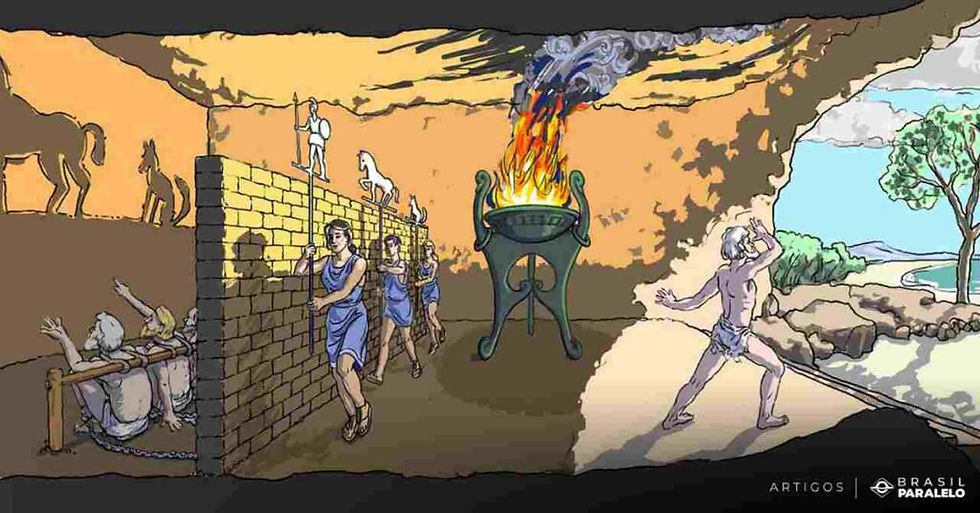
Ancient philosophers didn't have algorithms, but they deeply understood human nature. In The Republic, Plato created one of the most powerful images in the history of thought: the Allegory of the Cave.
Imagine prisoners chained since birth inside a cave. They can only look at a wall. Behind them, there is a fire and people carrying objects that cast shadows on the wall. For the prisoners, those shadows are reality. They have never seen the real world. And the most impressive part: they compete with one another to see who can best describe the shadows, who can best predict which shadow will appear next. Whoever stands out in this game of illusions receives praise, status, and “rewards” within the cave.
Now replace the cave with smartphone screens. Replace the shadows with reels, stories, trends, and viral opinions. Replace the “shadow experts” with influencers who ride the algorithm most effectively. The parallel is frighteningly accurate. Whoever best “reads the trends” (that is, whoever best describes the shadows of the moment) gains fame and money. Whoever tries to show that there is a real world outside, with complexity, evidence, and nuance, is usually ignored or ridiculed.
Socrates and the price of not examining one's own life
Socrates, Plato's teacher, was even more direct. Condemned to death for questioning the accepted beliefs of his time, he said something that still echoes today:
“The unexamined life is not worth living.”
For Socrates, following the crowd without questioning, accepting ready-made opinions just because “everyone is saying it”, is a form of intellectual death. True life requires constant examination: where does this idea come from? Who benefits from it? What evidence supports it? What do I really think, regardless of what's trending?
A necessary warning: think outside the box
This is not about rejecting everything that is popular, trends can be fun, harmless, or even useful. The problem begins when they replace independent thinking. When you stop consulting reliable sources to follow what has gone viral. When your worldview is shaped more by 15 seconds of content than by reflection, study, or direct experience.
Thinking outside the system requires deliberate effort:
Question the source: Who is speaking? What interest lies behind it (selling a product, engagement, power)?
Seek depth: Prefer verifiable experts over charismatic “personalities”. Read primary sources whenever possible.
Cultivate silence: Disconnect. Wisdom rarely appears in the endless scroll.
Value what is slow: True knowledge matures with time and effort. Not with views.
Leaving the cave hurts, but the prison hurts more
Leaving the cave is uncomfortable. The bright light is blinding at first. Fellow prisoners may mock or even attack the one who returns to tell them what they saw outside. Plato already knew this. But the alternative, living chained to the shadows, consuming what feeds our digital cage, is a much subtler, more comfortable, and longer-lasting prison.
True autonomy is not about choosing between trend A or B. It is about developing the ability to see beyond them. It is about reclaiming the right, and the duty, to think for yourself.
How about starting today? Turn off your phone for half an hour. Pick up a book, a dense article, or simply sit in silence with your own questions. Ask yourself honestly: “This thing I'm following, repeating, or desiring… did I really choose it, or was it sold to me disguised as my own desire?”
The answer may be uncomfortable. But that is exactly where the examined life begins, the only one that, according to the ancients, is truly worth living.
BY KETTY WILLIAMS